-
![]() info
info -
![]() info
info -
![]() info
info -
![]() info
info -
![]() info
info -
![]() info
info -
![]() info
info -
![]() info
info -
![]() info
info
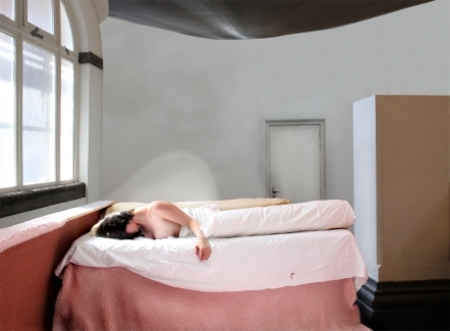
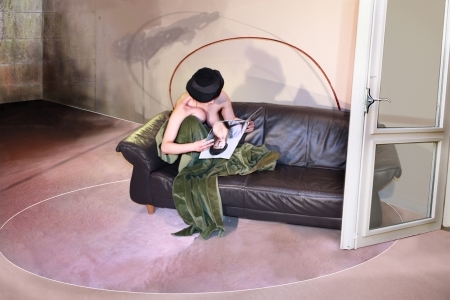
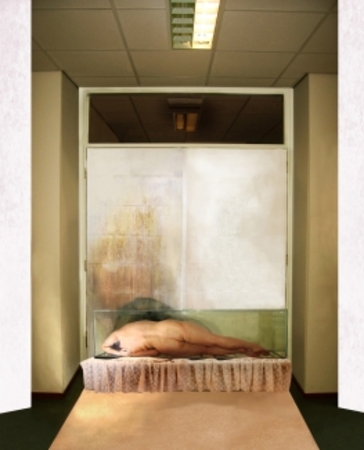
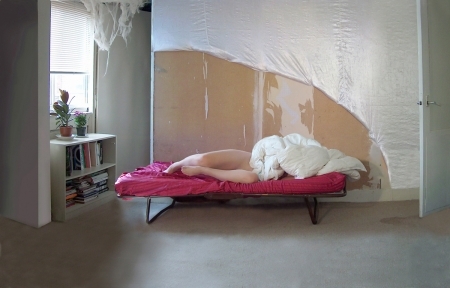
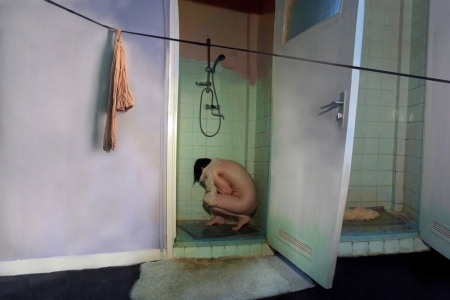
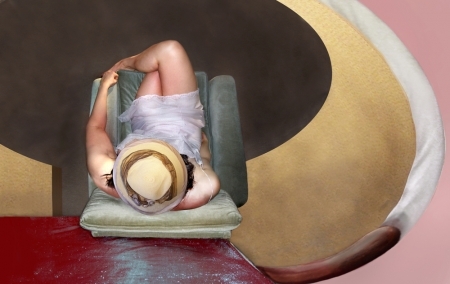
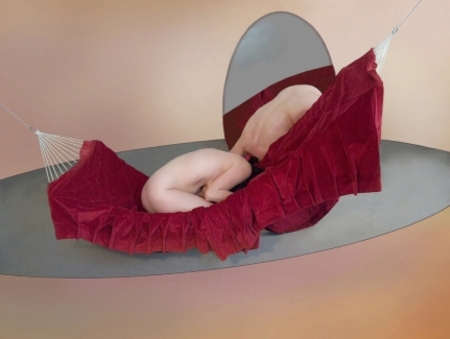
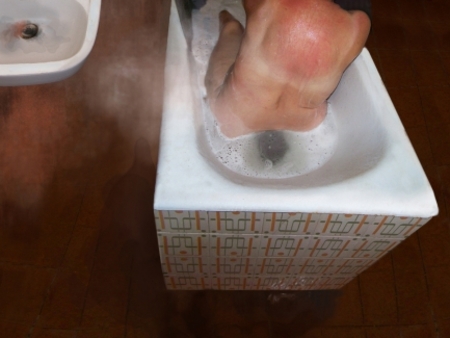
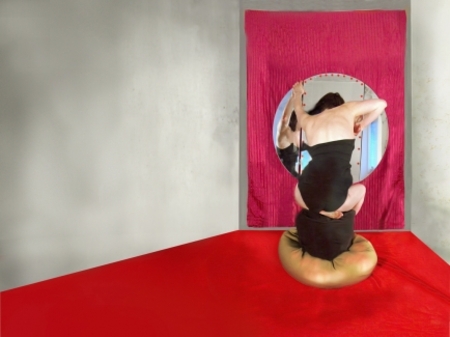
Jelena Opacic: "In my works I construct a scene and perform in it. I take photographs of my performances in the created space and then “repaint” the photos in Photoshop. Thus, my work is an image that lies somewhere in between a photograph and a painting. The photographic aspect of the work is a simulation of a view of a truthful, concrete space, as may be found in everyday life (e.g. a kitchen, a bathroom, a living room, a closet) and lies in a relationship of opposition to the other, “painted” part of the image. The latter focuses on the irrational side of the situation depicted in the scene. The tension produced by this conflict – the opposition between the photographic and the painted images – is a reflection of a psychological statement of a body that is formally placed in a particular space.
My recent work is not an objective investigation but a kind of personal research (and re-search; a kind of double take: looking again at and for myself). I utilize the female body in order to develop my own vision of myself. My work concentrates on my own emotional and personal relationships as a kind of diary of human intimacy that is, nonetheless, brought out in a very general manner. The body is placed in a setting which most of the time is at the limits of our experience and is presented as a symbol of receptivity having various roles and psychological positions. The human figure, its various shapes, its flesh, becomes an integral part of the architecture and surrounding structures in the constructed scene and vice versa. The environment in which it is placed, becomes a locus, a contact point, a meeting place between myself and the rest of the world. As such, the work constitutes a communicative model in which information about my experience is presented and reflected upon. My work attempts an aesthetic investigation in that it questions the interfaces between corporeal and the environmental and it also raises certain ethical questions such as the following: What is the nature of the distance between my body and the world? Where and how does the body connect with the world? Where does my body end and the world begin, is there an ending as such? And, Why can’t the body – not only the body as subject, but also, the body social – free itself?
The images appear in a context that can be read as specifically feminine. Sometimes they are eccentric, at others, they are provocative and erotic and they issue from the carnality of being a woman, from the specificity of women’s bodies as well as feminist concerns."
Samenwerkingsverband
-
Maakt deel uit van Kunstenaarsinitiatief / Collectief / Broedplaats
-
Lid van Beroeps- / Kunstenaarsvereniging
-
Curriculum vitae
Opleidingen
-
2004 - 2008Fine art Den Haag, Koninklijke Academie van Beeldende Kunsten Diploma behaald
tentoonstellingen
-
2008Grafisch Lyceum Utrecht Fred van der Ende( hoofdredacteur P/F) Nico Dielen( directeur Grafisch Lyceum Utrecht, Art&Design College), Hajo Hoffmann( fotograaf, bestuurslid SVFN) en Elsje van Ree( fotograaf, voorzitter SVFN) hebben een selectie gemaakt uit het werk van eindexamenstudenten van academies in Nederland. Groep
projecten
-
2008
Stoemp
publicaties
-
2008Jong Talent in Beeld P/F (Magazine for professional fotography)
Prijzen en stipendia
-
2008Eindexamen: Afdelingsprijs Beeldende Kunst KABK , Den Haag